International vs Local Schools for Expats

International schools admit foreign children directly and follow overseas curricula; local mainstream schools admit foreigners mainly through the MOE AEIS test, subject to vacancies, and most foreign students need a Student's Pass from ICA.
On this page6 sections · tap to jump
One of the biggest decisions for a family moving to Singapore is schooling. The choice is usually between an international school (overseas curriculum, open to foreigners) and a local mainstream school (MOE system, admission by test). They differ on how you get in, what your child studies, and cost. Here is a plain comparison with the official rules.
Getting in: the key difference
International schools admit foreign children directly, applying their own criteria and waitlists. They follow curricula such as the IB, British (IGCSE/A-Level) or American systems.
Local mainstream schools are run by the Ministry of Education (MOE). For foreigners, admission works like this:
- A child aged 6 as at 1 January of the admission year can seek a Primary 1 place through the P1 registration process for international students.
- A child aged 7 and above seeks admission through the Admissions Exercise for International Students (AEIS) — a centralised English and Mathematics test — for Primary 2–5 and Secondary 1–3. A Supplementary round (S-AEIS) runs for some levels.
The Student’s Pass rule
A foreign child studying in a mainstream school needs a Student’s Pass from ICA — unless they already hold a valid Dependant’s Pass, Long-Term Visit Pass or Immigration Exemption Order, in which case no separate Student’s Pass is required.
What your child will study
| Local mainstream (MOE) | International school | |
|---|---|---|
| Curriculum | Singapore national curriculum | IB, British, American and others |
| Language | English, plus a Mother Tongue Language | Usually English only |
| Key exams | PSLE (primary), national exams | School’s own system (e.g. IGCSE, IB) |
| Admission | AEIS/S-AEIS, by test and vacancy | Directly, by the school |
| Peer mix | Mostly Singaporean | Mostly international |
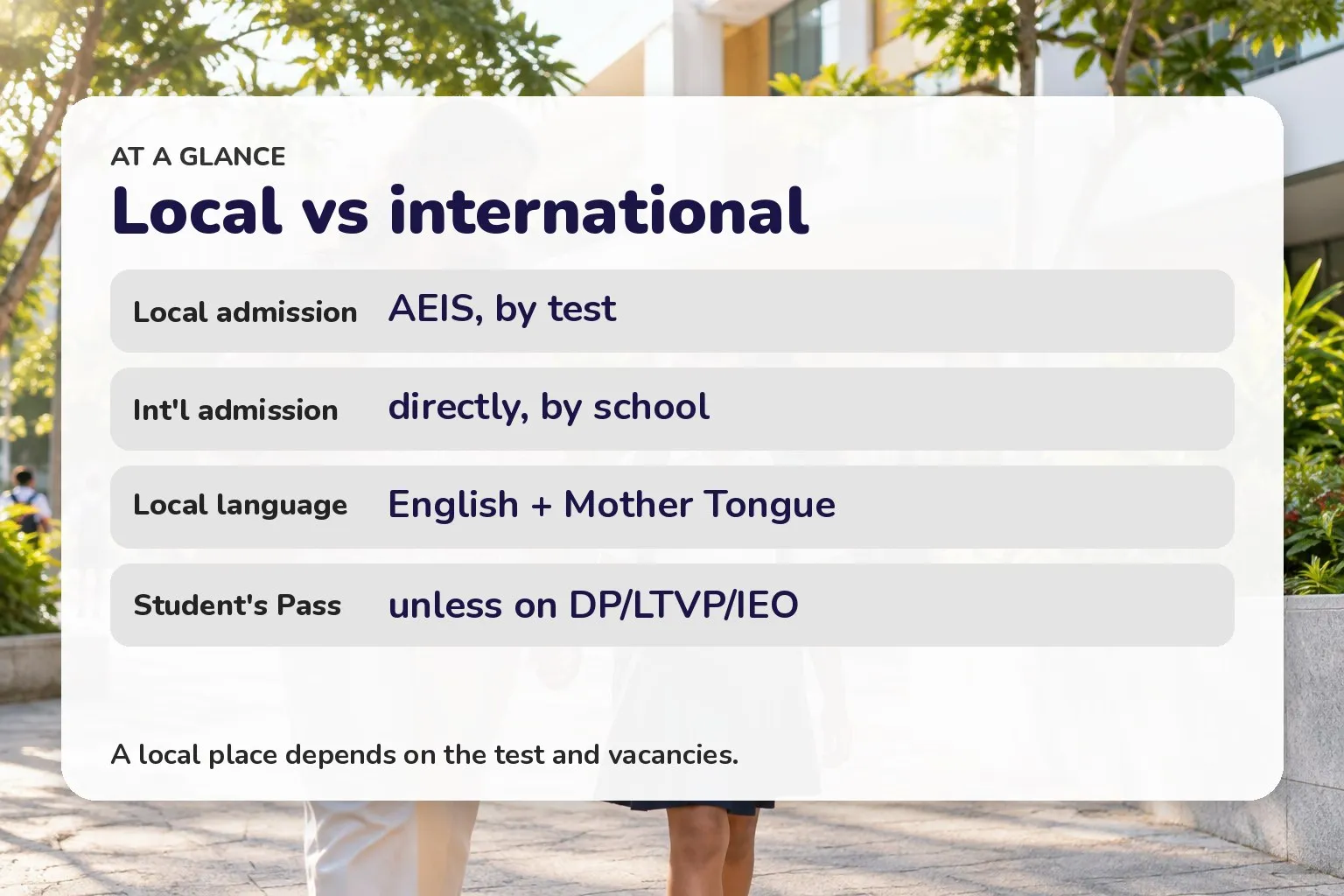
Key differences between local and international schools.
Costs, in outline
- Local schools charge foreigners more than citizens and PRs, and fees differ by nationality; MOE publishes a school-fees checker.
- International schools typically cost considerably more than local-school foreigner fees, varying widely by school and level.
- There are also one-off application costs — for example AEIS test fees and the ICA Student’s Pass processing fee — plus uniforms and materials.
The admission timeline
AEIS runs on a fixed annual calendar: applications typically open mid-year, the test is sat in the second half of the year, and outcomes and school postings are released around December, with successful pupils reporting in December or early January for the academic year that starts in January. A Supplementary round (S-AEIS) early in the year offers a second chance at some levels. Because places depend on vacancies and the calendar is rigid, applying before you move — or in your first months — avoids an unplanned gap year. International schools set their own intake dates and waitlists, so enquire early there too.
How to decide
- Map your likely length of stay and whether you may relocate again.
- Check your child’s pass type and whether a Student’s Pass is needed.
- For local schools, note the AEIS timing and that a place is not guaranteed.
- Compare total cost (fees by nationality, plus extras) honestly.
- Shortlist and contact schools early.
Related
See how a Dependant’s Pass covers your children, and sort healthcare for the family as a non-resident.
General information only, from MOE and ICA, with the date each rule was checked. We are not an education or immigration agent. Confirm the current rules and fees on the official MOE and ICA pages for your own case.
Sources
- Admissions process for international students — Ministry of Education (as of October 2026)
- Student's Pass — Government/Government-Aided/Independent Schools — Immigration & Checkpoints Authority (as of October 2026)